If all Indians are Hindus, why every Hindu can't be a Brahmin?
After all, if Muslims and Christians can be subsumed under the “Hindu” category simply by virtue of living in India and sharing its cultural space, why cannot Dalits, Shudras, and OBCs be elevated to Brahmin status by the same reasoning?
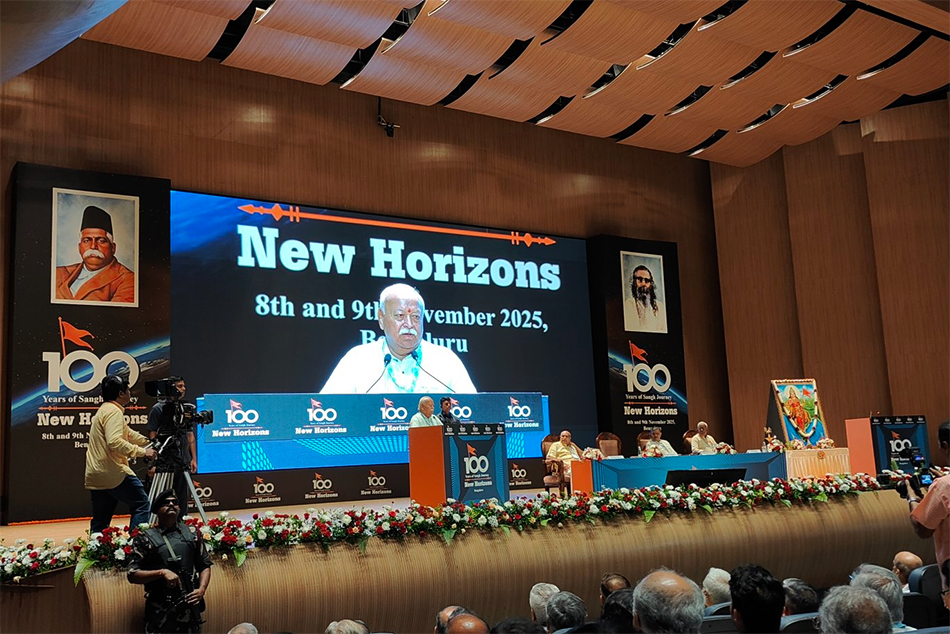
Last month in Bengaluru, RSS Chief Mohan Bhagwat stood before a fawning audience and delivered what he likely considered a masterstroke of rhetorical generosity.
Muslims and Christians, he declared, are welcome in the RSS — provided they shed their “separateness” and come as “Hindus,” as “sons of Bharat Mata,” as members of the “Hindu society.”
With this single formulation, Bhagwat sought to perform a sleight of hand: To appear inclusive while demanding absolute submission, to extend a hand while concealing the chains that come with it.
This is not unity. This is not synthesis. This is the ancient logic of hierarchy dressed in the borrowed robes of cultural nationalism — a devious reimagining of India’s diverse tapestry as a monochrome canvas where all colours must blend into saffron or be painted over entirely.
The Poisoned Chalice of “Hindu”
Let us examine what Bhagwat offers. He tells us that “Hindu” is not a religious term but a cultural and nationalist one — that it encompasses all who trace their ancestry to this land.
By this sleight of definition, an Indian Muslim becomes a “Hindu Muslim,” an Indian Christian becomes a “Hindu Christian,” and the magnificent diversity of India’s spiritual landscape collapses into a single, monolith category. (The distinct identity of Sikhs, Jains, Buddhists and various Adivasi faiths has already been swallowed and digested long ago by Hindutva ideologues)
This is linguistic imperialism at its finest. By redefining the word “Hindu” to mean “Indian,” the RSS seeks to accomplish several objectives simultaneously: To sidestep accusations of majoritarianism (how can we be anti-minority when we say everyone is Hindu?) and to delegitimize the separate identities of religious minorities (you’re not really Muslim or Christian, just Hindu with peculiar habits).
Most insidiously it is meant to consolidate an age-old hierarchy where those who practice “true” Hinduism — as defined by upper-caste Brahmanical traditions, sit at the apex, while all others are tolerated as degraded variants occupying the lowest rungs of the social order.
When Bhagwat says Muslims and Christians must leave their “separateness” outside the shakha, what precisely must they abandon?
Their Friday Prayers and Sunday Mass?
Their dietary practices and marriage customs?
Their prophets and their saints?
Their entire cosmology and theological framework?
And in return for this wholesale erasure of identity, what do they receive?
The privilege of being called “Hindu” — a term that, despite Bhagwat’s protestations, carries unmistakable religious and caste connotations in the Indian context?
The Architecture of a Hindu Rashtra
The RSS’s vision of a “Hindu Rashtra” is not some egalitarian utopia where all Indians, regardless of faith, stand as equals. It is a restoration project — an attempt to resurrect and sanctify the ancient varna system that has structured Indian society for millennia.
In this imagined order, Muslims and Christians — along with Dalits and Adivasis, would occupy the margins, granted space only in so far as they acknowledge their subordinate status and perform obeisance to the cultural and religious supremacy of upper-caste Hinduism.
They would be, in essence, the new “untouchables” of a reimagined caste system, their religions reduced to “denominations” (Bhagwat’s word) within the grand narrative of Hindu civilization.
It is historical revisionism in service of contemporary domination, something the RSS has always excelled in.
Why Stop at Hindu? Why Not Declare us All Brahmins?
But here is a question worth posing to Bhagwat: If he is so committed to this expansive redefinition of identity, why stop at “Hindu”?
Why not take the logic to its natural conclusion and declare all Indians to be Brahmins?
After all, if Muslims and Christians can be subsumed under the category “Hindu” simply by virtue of living in India and sharing its cultural space, why cannot Dalits, Shudras, and OBCs be elevated to Brahmin status by the same reasoning?
By Bhagwat’s own logic of geographic and cultural unity, what prevents him from declaring that every Indian, from the Dalit to the Adivasi to the Muslim, is a Brahmin?
One can imagine the response: Nervous laughter, perhaps, followed by elaborate theological explanations about varna and dharma, about ritual purity and spiritual qualifications, about the need to preserve ancient traditions and sacred knowledge.
But the real reason for his hesitation would be far simpler and more revealing: Mohan Bhagwat is himself a Brahmin, and the Brahmin identity derives its entire meaning and power from exclusivity. To make everyone a Brahmin would dilute this special pool beyond recognition, destroying the very hierarchy that gives the category its social and political capital.
This is where the game reveals itself. The expansive redefinition of “Hindu” costs the RSS nothing — indeed, it gains them everything, allowing them to claim hegemony over all Indians while maintaining internal hierarchies intact. But to extend the same logic to caste would require them to surrender the apex position, to give up the privileges that come with Brahmanical status, to genuinely embrace equality rather than merely performing the theatre of inclusion.
And so the borders are drawn precisely where self-interest dictates: Religion can be made porous and encompassing, but caste must remain rigid and hierarchical. Muslims and Christians can be told they are really Hindus, but Dalits and Shudras cannot be told they are really Brahmins. The rhetoric of unity extends only as far as it serves the interests of those already at the top.
If All Are Hindus, Are All Hindus also Muslims and Christians?
But let us play Bhagwat’s game and follow his logic to its necessary conclusion. If Muslims and Christians can be called Hindus because they share Indian ancestry and participate in Indian culture, then by the same token, all Hindus must also be Muslims and Christians.
After all, can any Hindu claim immunity from over ten centuries of Islamic influence in India?
The Hindi/Urdu you speak, with its Persian and Arabic vocabulary, is Muslim. The architectural marvels that attract millions from around the world to India — from the Taj Mahal to the Charminar, are Muslim. Even your administrative systems, your revenue structures, your courtly etiquette, are borrowed from the Mughals and Sultanates.
And Christianity? The colleges and hospitals that educated and healed generations of Indians, the social reform movements that challenged caste oppression, the very ideals of equality and social justice that animate our Constitution — all bear the mark of Christian thought and Christian activism in India. Even more fundamentally, the shirts and pants we wear (including the RSS’s khaki shorts) or the language I am writing this article in — English, can also be rightly called Christian in origin (assuming Bhagwat’s own way of thinking about such things).
And beyond these two? Where does the Hindu end and the Buddhist begin, when the Buddha himself was born a Hindu prince and his teachings permeate Hindu philosophy?
Where is the boundary with Jainism, whose principle of ahimsa (non-violence) suffuses Hindu ethical thought?
How do you extract Sikhism from the equation, born as it was from the synthesis of Hindu and Islamic mysticism?
And what of the Adivasis — India’s first peoples, whose animistic traditions, whose worship of trees and stones and spirits, whose ecological wisdom and communal ethos predate the arrival of all organized religions in this subcontinent? Their influence runs like an underground river through Indian civilization, nourishing practices and beliefs that have been appropriated as “Hindu” but which existed long before the Vedas were composed or the Upanishads contemplated.
By What Authority does Bhagwat Speak?
But here is the most fundamental question of all: What right does Mohan Bhagwat have to make any grand pronouncements about Hindus, Muslims, Christians, or the people of India in general?
Being the head of the RSS does not confer upon him the status of some kind of Viceroy of India, authorized to redefine identities and prescribe terms of belonging for the nation’s citizens. The RSS, for all its claimed influence and organizational reach, does not even maintain a membership record — it remains an opaque entity, accountable to no one, elected by no one, representing no one except itself. (For all we know, it is the same few thousand people who turn up in various avatars – as RSS cadre, as Bajrang Dal goons, as VHP functionaries, as BJP ministers – and maybe some even dressed as Durga Vahini activists?)
Besides, Bhagwat - for all the grand pronouncements he tends to make about Hinduism, is not a religious scholar who has made contributions to Hindu philosophical thought. He is not a theologian who has enriched spiritual traditions or practices. He is not a reformer who has worked to heal the wounds of caste or bridge the divides of community. He is, simply put, the administrator of a large organization — one that has made it its business to misrepresent culture, manipulate history, and exploit the spiritual sentiments of people for narrow political purposes.
This record, far from qualifying him to speak on affairs of the Indian nation or the Hindu population, actively disqualifies him from doing so with any credibility. His pronouncements carry no moral weight, no intellectual authority, no democratic legitimacy.
The people of India, in all their glorious diversity of faith, caste, language, and custom – all protected explicitly by the Indian Constitution, owe Mohan Bhagwat neither obedience nor attention.
India has survived and thrived for millennia not despite our diversity but because of it. We have absorbed wave after wave of new peoples, new ideas, new gods, and we have emerged stronger, richer, more complex. This is our genius — not purity but porosity. Let us not let a bigot, or for that matter a Bhagwat, deliberately distort the past and play dangerous games with our present and future.
[The writer, Satya Sagar, is a Journalist and Public Health Worker who can be reached at sagarnama@gmail.com.]
Follow ummid.com WhatsApp Channel for all the latest updates.
Select Language to Translate in Urdu, Hindi, Marathi or Arabic